
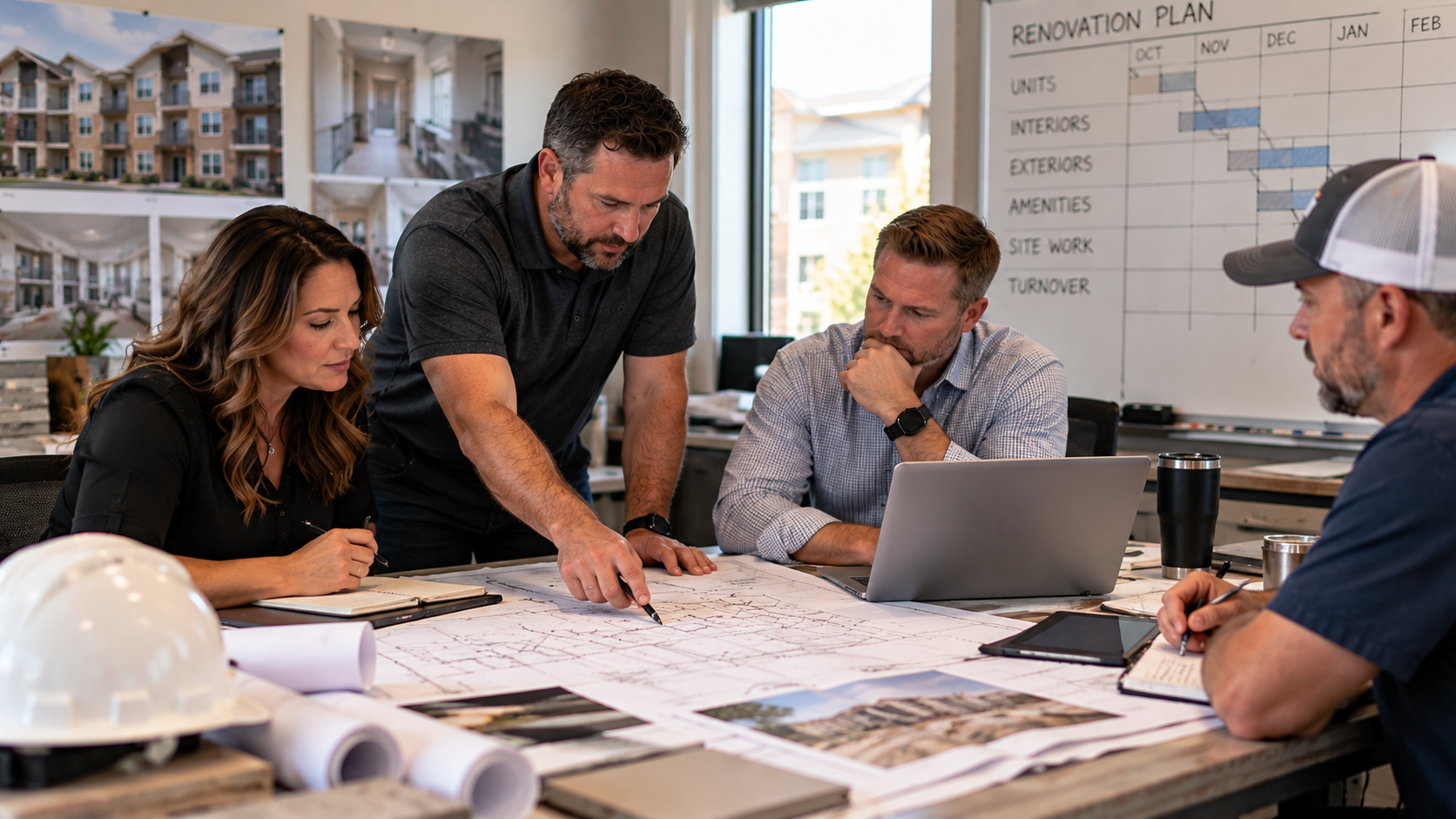
More Multifamily Owners, Developers, and Operators are evaluating whether to bring construction and renovation capabilities in-house rather than relying entirely on outside partners.
The reasons are understandable: greater control over project execution, improved visibility into budgets and schedules, more consistent construction standards, and the ability to support growing renovation programs across multiple properties or markets.
But bringing construction capabilities in-house involves much more than hiring a few experienced construction professionals.
Building a successful internal Multifamily Renovation team requires understanding the construction model, establishing the right leadership structure, and identifying professionals whose experience aligns with the organization’s long-term objectives.
Before founding Bridge Partners of Texas, I served as the sole in-house recruiter for five affiliated Multifamily Renovation businesses. That experience gave me firsthand exposure to the challenges of recruiting construction leadership, building field teams, and supporting operations across multiple markets.
Over more than 12 years specializing in Multifamily Renovation recruiting, I’ve learned that hiring talented individuals is only part of the equation.
The real challenge is building a team with the right combination of experience, leadership, and operational capabilities to execute the work successfully.
And that process should begin long before the first position is posted.
Start With the Construction Model, Not the Organization Chart
One of the most common mistakes organizations can make when developing an internal construction team is starting with job titles before clearly defining the work.
Vice President of Construction. Director of Construction. Construction Manager. Project Manager. Superintendent.
These are familiar positions, but their responsibilities can vary significantly depending on how the organization intends to operate.
Before determining who to hire, Owners and Developers need to establish what their internal construction team will actually be responsible for.
Will the organization oversee outside General Contractors, or will it self-perform construction management and execution through an internal general contracting division?
Will the team support a single portfolio or multiple properties across different markets?
Will projects consist primarily of interior unit renovations, exterior capital improvements, repositioning, occupied rehabilitation, or a combination?
Will the portfolio include Market Rate properties, Affordable Housing communities, or both?
And how will construction responsibilities intersect with Asset Management, Property Management, Development, and other internal departments?
The answers to these questions should drive the organizational structure, not the other way around.
A construction team designed around the wrong assumptions can create overlapping responsibilities, operational inefficiencies, and costly hiring mistakes.
Owner-Side Oversight and Internal GC Operations Require Different Talent
One of the most important distinctions an Owner or Developer must make is whether the internal team will oversee construction or actually execute it.
An Owner’s Representative or Construction Manager may be responsible for managing third-party General Contractors, monitoring budgets and schedules, reviewing change orders, coordinating with Property Management, and ensuring construction aligns with ownership’s objectives.
These professionals serve as the connection between ownership’s investment strategy and the contractors responsible for executing the work.
An internal general contracting operation requires a different level of infrastructure and accountability.
That may include Estimating, Preconstruction, subcontractor procurement, field supervision, scheduling, safety, quality control, financial management, and direct responsibility for construction execution.
Both models can be effective, but they require different leadership profiles, staffing structures, and operational capabilities.
A highly accomplished Owner’s Representative may understand capital planning, contractor oversight, and portfolio-level construction management without having experience building and managing a field production operation.
Likewise, an experienced General Contractor executive may have extensive knowledge of construction execution but need to adapt to an ownership environment where asset performance, investment priorities, and property operations influence project decisions.
Understanding these differences before recruiting begins can prevent an organization from hiring the right person for the wrong job.
Ground-Up Construction Experience Doesn’t Automatically Translate to Renovation
Many Multifamily Owners and Developers have established relationships with talented ground-up construction professionals.
Those relationships are valuable, but ground-up construction and Multifamily Renovation operate under different conditions.
Ground-up projects generally begin with greater control over site access, construction sequencing, and project conditions.
Renovation projects often involve existing buildings, incomplete information, unforeseen conditions, and active communities where residents continue living throughout construction.
In occupied Multifamily Renovation, field leaders may be responsible for coordinating hundreds of unit renovations while maintaining aggressive production schedules, managing subcontractors, communicating with Property Management, and minimizing disruption to residents.
A professional who has successfully managed a $50M ground-up project may not be immediately prepared to oversee a $20M occupied Affordable Housing renovation.
That doesn’t mean ground-up professionals cannot make the transition. Many absolutely can.
The key is understanding which skills transfer, which experiences are essential, and where additional support or development may be required.
When evaluating candidates, I look beyond project size and job titles to understand how they’ve managed production, responded to unforeseen conditions, coordinated subcontractors, and operated within occupied environments.
Those conversations often reveal far more about a candidate’s ability to succeed than their résumé alone.
Market Rate and Affordable Housing Require Different Experience
An internal Multifamily Renovation team may support both Market Rate and Affordable Housing properties, but the experience requirements should not automatically be treated as interchangeable.
Market Rate renovation programs often focus on value-add improvements, property repositioning, unit upgrades, amenity renovations, exterior improvements, and capital projects designed to improve asset performance and resident experience.
Affordable Housing rehabilitation can introduce additional requirements involving Low-Income Housing Tax Credit (LIHTC) programs, HUD, Housing Authorities, accessibility compliance, resident relocation, inspections, and tenant-in-place construction.
These differences influence staffing requirements, project execution, and the type of leadership needed.
A Construction Manager overseeing exterior CapEx projects across a Market Rate portfolio may bring valuable experience but may not have the background necessary to manage a large-scale Affordable Housing rehabilitation program involving occupied unit renovations and complex compliance requirements.
Conversely, a professional with extensive Affordable Housing renovation experience may have highly transferable skills for Market Rate projects.
The objective isn’t to determine which background is better. It’s to identify the experience that best supports the organization’s construction model and portfolio needs.
Define Leadership Before Hiring the Team Beneath It
One of the most consequential hiring decisions an Owner or Developer can make is selecting the individual who will build and lead the internal construction operation.
That first leadership hire often influences every hire that follows.
The individual may be responsible for establishing reporting structures, implementing project controls, developing vendor relationships, creating operational processes, building teams, and defining accountability across multiple projects or markets.
But there’s an important distinction that organizations sometimes overlook.
Managing an established construction operation and building one from the ground up are two very different responsibilities.
A strong Project Executive may be exceptional at delivering projects but have limited experience developing an entire construction organization.
Likewise, a seasoned Vice President of Construction may have successfully managed large teams within an established company without ever being responsible for creating those teams, systems, and processes.
Neither background is inherently better. The right choice depends on what the organization needs that individual to accomplish.
Before beginning a leadership search, I encourage employers to consider several questions:
- Will this person be responsible for strategy, execution, team development, or all three?
- Are they inheriting an established team or building one from scratch?
- What level of financial and operational authority will they have?
- Will they oversee one market, multiple regions, or a national construction program?
- How will success be measured beyond completing projects on time and within budget?
- What relationships will they need to establish with ownership, asset management, property management, and outside contractors?
The answers may point toward a Director of Construction, Vice President, Project Executive, or experienced Construction Manager.
The title should reflect the responsibility, not dictate it.
Build the Talent Strategy Before You Build the Team
Once the construction model and leadership requirements are defined, the next step is determining how to build the team effectively.
A talent strategy should address more than the number of positions an organization intends to fill.
It should establish which capabilities are needed first, which responsibilities can remain with outside partners, and how the team will evolve as the renovation program grows.
For example, an organization launching an internal renovation division may benefit more from hiring an experienced construction leader capable of establishing processes and building teams than immediately adding several Project Managers or Superintendents.
A company that plans to continue utilizing outside General Contractors may instead prioritize experienced Construction Managers or Owner’s Representatives who can oversee multiple projects and protect ownership’s interests.
The strategy should also account for geography, project volume, travel expectations, compensation, and long-term growth.
Will Project Managers be assigned by region or project type?
Will Superintendents be local or traveling?
Who will oversee Preconstruction, Estimating, procurement, scheduling, and quality control?
How will the team maintain consistency as the portfolio expands?
And perhaps most importantly, does the proposed staffing structure reflect the actual workload and complexity of the projects being planned?
Answering these questions early helps organizations recruit with greater precision and reduces the likelihood of hiring professionals into roles that change substantially after they arrive.
Key Roles Depend on the Delivery Model
Not every internal Multifamily Renovation team requires the same positions.
The appropriate structure depends on whether the organization is overseeing outside contractors, managing construction internally, or establishing a fully operational general contracting division.
Construction Managers and Owner’s Representatives
These professionals often represent ownership’s interests throughout the construction process.
Responsibilities may include overseeing third-party General Contractors, monitoring budgets and schedules, reviewing change orders, coordinating with internal stakeholders, and ensuring projects align with ownership’s objectives.
This role can be especially important for Owners and Developers who want greater visibility and control without assuming direct responsibility for field execution.
Project Managers
Project Managers may oversee day-to-day project delivery, financial performance, scheduling, change management, contractor relationships, and coordination between field operations and internal leadership.
However, their responsibilities can vary considerably between an owner-side construction team and an internal GC operation.
Understanding the level of authority and accountability associated with the position is essential when evaluating candidates.
Superintendents
Superintendents are responsible for field execution, including subcontractor coordination, production schedules, safety, quality, and daily construction operations.
For occupied Multifamily Renovation projects, experience managing resident access, repetitive unit production, changing conditions, and coordination with Property Management can be particularly valuable.
Depending on project geography, these positions may be local, regional, or national traveling roles.
Directors and Vice Presidents
Construction Directors and Vice Presidents may oversee multiple projects, develop operational standards, establish accountability, manage teams, and provide leadership across markets or business units.
These roles require more than technical construction knowledge.
They require the ability to develop people, manage financial and operational performance, and align construction execution with organizational objectives.
Executive Construction Leadership
Organizations building substantial internal construction operations or general contracting divisions may require executive leadership capable of establishing the broader business model.
Responsibilities may include organizational strategy, financial controls, risk management, operational development, market expansion, and long-term team building.
The right organizational structure isn’t necessarily the one with the most layers. It’s the one that provides the leadership, accountability, and expertise necessary to execute the work.
Avoid Hiring One Person to Solve an Undefined Problem
I’ve encountered situations where organizations are searching for a candidate who can seemingly do everything.
Build the department. Manage projects. Oversee Estimating. Develop subcontractor relationships. Lead field operations. Establish processes. And support future growth.
Occasionally, an individual with that combination of experience exists.
But more often, an overly broad job description indicates that the organization hasn’t fully defined its operational needs.
That creates challenges throughout the recruiting process.
Candidates may interpret the position differently. Compensation becomes difficult to establish. Interviewers may prioritize different responsibilities. And the individual ultimately hired may discover that leadership’s expectations don’t align with the role they believed they were accepting.
Before searching for someone who can do everything, it’s important to determine what actually needs to be done and which responsibilities realistically belong to one position.
Sometimes the solution is a senior leader capable of building the operation.
Other times, the organization needs several specialized professionals or a phased hiring strategy supported by outside partners.
A clearly defined role makes it easier to identify qualified candidates, establish realistic compensation, and create expectations that support long-term success.
Bring Specialized Recruiting Into the Conversation Early
One of the advantages of involving a specialized recruiter early is the ability to evaluate the talent market before an organizational structure becomes fixed.
A company may have a clear vision for its internal construction operation but limited insight into the availability of professionals with the specific combination of experience it requires.
For example, finding a construction executive who has managed occupied Affordable Housing renovations is one challenge.
Finding someone who has also built an internal construction division, established operational processes, developed teams across multiple markets, and successfully worked within an ownership organization is a considerably narrower search.
Understanding those distinctions early can help employers establish realistic expectations around candidate availability, compensation, responsibilities, and hiring timelines.
My role isn’t to design a client’s construction business. It’s to understand that business well enough to help identify the people capable of building and supporting it.
Having spent more than 12 years specializing in Multifamily Renovation recruiting, I’ve developed an understanding of the professionals working within this sector, the responsibilities they’ve held, and the experience that differentiates them.
That knowledge allows me to have meaningful conversations with clients about the type of talent they’re seeking and whether the expectations of the position align with the available candidate pool.
The Cost of a Wrong Early Hire Extends Beyond the Position
When an organization is establishing an internal construction team, its first hires often have an outsized influence on the success of the operation.
Those individuals may shape the company’s processes, vendor relationships, reporting structures, culture, and future hiring decisions.
A poor fit can create consequences extending far beyond the cost of replacing one employee.
It can delay projects, create confusion between departments, weaken confidence in the internal construction model, and make future recruiting more difficult.
That’s why I believe the strongest protection against a poor hiring decision begins before candidates are ever interviewed.
It begins with clearly defining the construction model, understanding the responsibilities of the position, and evaluating candidates against the experience required to succeed.
Building the Right Team Starts With the Right Strategy
Building an internal Multifamily Renovation team is more than an organizational decision.
It’s an investment in the people who will ultimately be responsible for protecting assets, executing capital improvement strategies, managing construction operations, and delivering projects successfully.
At Bridge Partners of Texas, I work with Multifamily Owners, Developers, Operators, General Contractors, and Construction Management firms to identify professionals capable of supporting those objectives.
With more than 12 years specializing in Multifamily Renovation recruiting, over 600 personal career placements, and firsthand experience recruiting across multiple affiliated construction businesses, I understand the importance of aligning talent with the organization’s construction model and long-term goals.
Whether you’re hiring your first Director of Construction, building an internal renovation division, or expanding an established team, the right talent strategy begins with understanding the business you’re building.
Because successful construction operations aren’t built around job titles. They’re built around the right people, in the right roles, with the experience to deliver.
Considering building or expanding your internal Multifamily Renovation team? Discuss Your Hiring Needs with Bridge Partners of Texas.
Frequently Asked Questions
Which role should an Owner or Developer hire first for an internal renovation team?
There is no universal first hire. The appropriate position depends on the organization’s construction model and the responsibilities the internal team will assume.
A company overseeing outside General Contractors may benefit from an experienced Construction Manager or Director of Construction. An organization building an internal general contracting division may need a senior operations or executive leader capable of establishing systems, developing teams, and overseeing construction execution.
Can a ground-up construction leader transition into Multifamily Renovation?
Yes. Many ground-up construction professionals have skills that transfer into renovation.
However, the transition should be evaluated carefully, particularly when projects involve occupied communities, changing existing conditions, repetitive unit production, resident coordination, and aggressive renovation schedules.
The objective is to understand which skills transfer and where direct renovation experience may be necessary.
Does an internal team need separate Market Rate and Affordable Housing experience?
Not necessarily. The answer depends on the portfolio and the type of work being performed.
While many construction management skills transfer between Market Rate and Affordable Housing renovations, Affordable Housing rehabilitation may involve additional requirements related to LIHTC, HUD, Housing Authorities, accessibility, resident relocation, compliance, and tenant-in-place construction.
Organizations should identify which experiences are essential before defining the position.
Should superintendents be local or traveling?
That depends on project locations, pipeline stability, construction volume, and the organization’s operating model.
A concentrated regional portfolio may benefit from local field leadership, while a national renovation program may require experienced traveling Superintendents capable of moving between projects.
Travel expectations, rotations, housing arrangements, and compensation should be clearly established before recruiting begins.
When should an Owner or Developer involve Bridge Partners of Texas?
Ideally, before the organizational structure and job descriptions are finalized.
Early conversations can help clarify the appropriate level of hire, realistic combinations of responsibilities, compensation expectations, travel requirements, and the specific construction experience necessary to support the organization’s goals.