
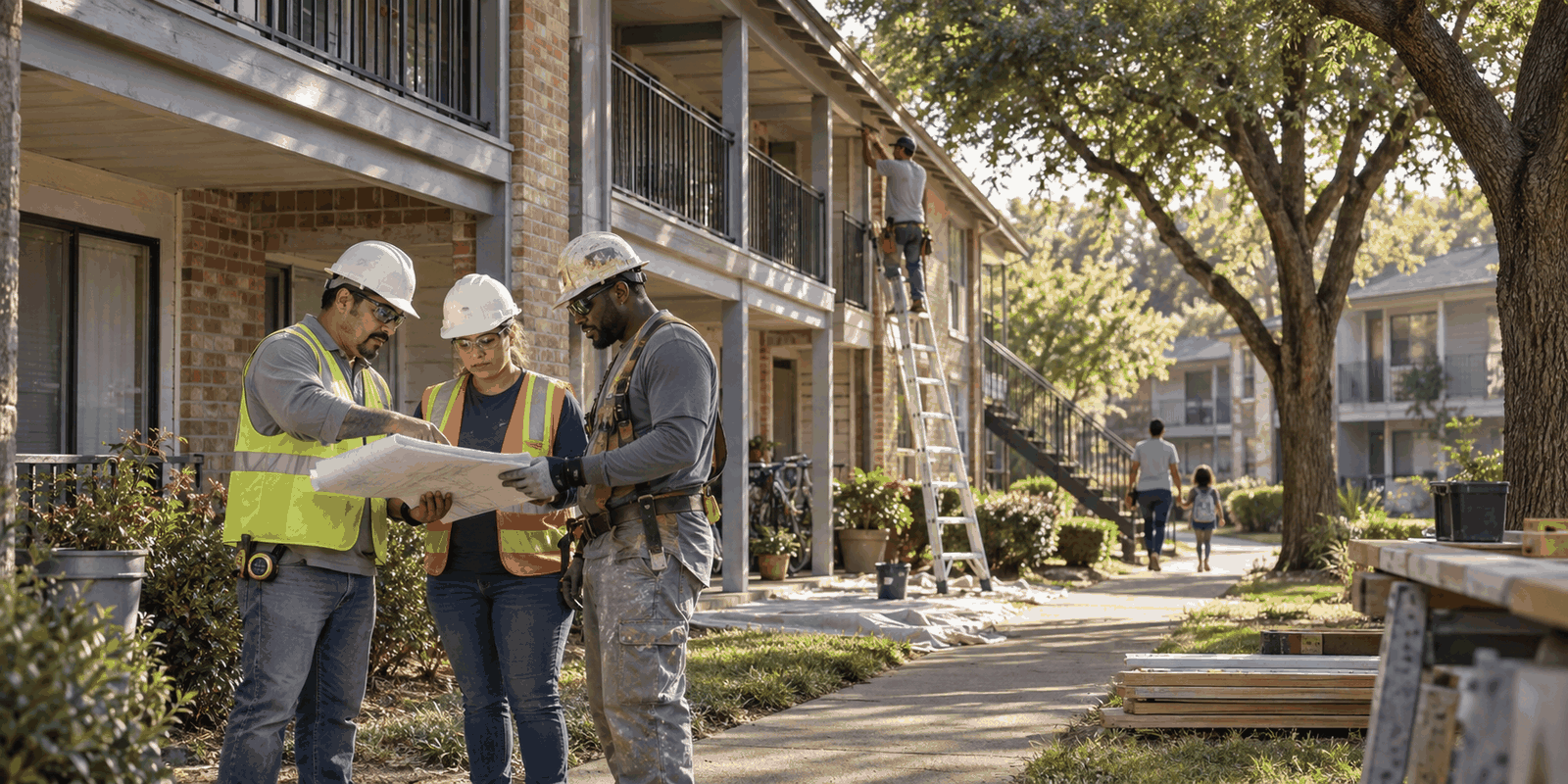
A Superintendent can successfully manage a $100 million ground-up construction project and still struggle with a $20 million occupied Affordable Housing rehabilitation.
Not because the construction is necessarily more complicated, but because the pace, people, and operating environment are fundamentally different.
After more than 12 years specializing in Multifamily Renovation recruiting, I've learned that the strongest construction résumé doesn't always translate into the right hire.
And in this industry, getting that decision wrong can be costly.
The Difference Is in the Details
One of the biggest misconceptions about Multifamily Renovation is that experience in one environment automatically translates into another.
Take Market Rate and Affordable Housing renovations.
Both typically take place within occupied apartment communities, but the way the work is executed can look very different.
In many Market Rate value-add programs, interior renovations begin after a resident's lease expires and the unit becomes vacant. A Superintendent may have approximately 30 days to complete the renovation before the next resident moves in.
Occupied Affordable Housing rehabilitation can operate on an entirely different production schedule.
On some projects, residents are temporarily relocated to hotels while construction teams renovate 12–14 units within a two-week window. Once the work is completed, residents return to their homes, and the next phase begins.
That's a significant difference in production expectations.
Now factor in resident coordination, multiple trades working simultaneously, inspections, unforeseen conditions, and the documentation required to keep everyone informed.
The Superintendent isn't simply managing construction. They're managing an entire production process with very little room for disruption.
Someone accustomed to a more traditional renovation schedule may understand the work perfectly well but struggle with the speed and coordination required to execute it.
That's why I want to know how a candidate's projects were actually run—not just what type of construction appears on their résumé.
Construction Knowledge Matters. Temperament Matters Just as Much.
A successful Affordable Housing Superintendent needs strong, hands-on construction knowledge. They need to read plans, understand the trades, recognize quality issues, and know how to keep a project moving.
But technical ability is only part of the equation.
Occupied renovation has an enormous people component that isn't typically present to the same degree in ground-up construction.
Some properties are located in neighborhoods with elevated safety concerns. Others have experienced years of deferred maintenance or challenging living conditions.
Residents aren't always excited about construction taking place in their homes. They may be frustrated, skeptical, or simply tired of the disruption.
And understandably so.
Construction is noisy, invasive, and inconvenient. Even when the improvements are desperately needed, the process can be difficult for the people living through it.
A Superintendent must navigate those realities while managing subcontractors, coordinating with property management, and maintaining an aggressive production schedule.
That takes a particular temperament.
The strongest Superintendents I've encountered are confident and firm, but fair. They know how to hold people accountable without creating unnecessary conflict. They communicate clearly, treat people with respect, and understand when a situation requires compassion rather than confrontation.
They also know how to adapt.
Mistakes will happen. Schedules will change. Unexpected conditions will arise. A strong field leader addresses the problem, adjusts the plan, and moves forward without allowing frustration or ego to take over.
In occupied renovation, the ability to manage people can be just as important as the ability to manage construction.
Organization and Communication Are Part of Production
One of the areas I believe hiring managers sometimes underestimate is the level of organization and communication required in these roles.
A great Superintendent isn't simply keeping subcontractors on schedule.
They're keeping Owners, Owner's Representatives, Project Managers, Property Managers, Assistant Superintendents, and subcontractors informed and aligned.
Everyone needs accurate information about production, access, inspections, delays, and upcoming work.
And that information needs to be timely.
Daily reporting, extensive photographic documentation, schedule updates, and clear written communication are essential parts of the job.
A Superintendent may be exceptional in the field, but if they cannot maintain accurate documentation, communicate effectively, or keep multiple parties organized, problems can develop quickly.
That's why I pay close attention to how candidates describe their responsibilities.
Do they understand the importance of daily reporting? Are they comfortable with construction management software? Can they communicate clearly in writing? How do they keep their teams informed when conditions change?
These aren't secondary administrative skills.
They're part of successfully managing the project.
What I Look for Beyond the Résumé
When I recruit, I prefer to let candidates do most of the talking.
I want to hear how they describe their experience, the projects they've managed, the decisions they've made, and the challenges they've encountered.
Those conversations often reveal far more than a list of employers, job titles, and project values.
I listen for how they approach problems, communicate, take responsibility, and work with others.
A candidate may have 20 years of construction experience, but that doesn't tell me whether they're organized, adaptable, or comfortable with the pace of occupied rehabilitation.
Likewise, someone with smaller project budgets may have exactly the production experience and leadership style a client needs.
Once I believe a candidate's background could align with a position, I dig deeper.
I evaluate their experience against the client's actual construction model, organizational structure, and expectations. We discuss company culture, project locations, travel requirements, compensation, and what would motivate them to consider a change.
I'm also transparent about the opportunity.
That means discussing the good, the bad, and the ugly—not simply selling the position.
Candidates deserve to understand the company they're considering, the realities of the job, and what they can reasonably expect during their first year.
Employers deserve the same level of transparency about the people they're considering hiring.
A successful placement starts with both sides understanding what they're walking into.
The Wrong Hire Costs More Than a Salary
Hiring the wrong construction leader can create problems that extend well beyond the cost of replacing that individual.
For a General Contractor, poor field leadership can lead to production delays, subcontractor disputes, frustrated clients, and strained relationships with property management.
Communication breaks down. Internal teams become frustrated. Problems that should have been addressed early begin affecting the broader project.
In more serious situations, the consequences can include losing a project, damaging a client relationship, or missing future business opportunities.
And the impact doesn't necessarily stop when the employee leaves.
A disruptive leader can damage team morale, subcontractor relationships, and the organization's reputation long after the position has been filled again.
That's why I believe temperament, communication, and cultural alignment deserve as much attention during the hiring process as technical qualifications.
A candidate doesn't need to have the same personality as everyone else on the team. But they do need to be capable of working effectively within the organization's operating environment.
The objective isn't simply to fill a position.
It's to identify someone who can contribute to the success of the project and the people around them.
There's a Reason People Build Careers in This Industry
Occupied Multifamily Renovation isn't always glamorous.
The working conditions can be challenging, the schedules demanding, and the projects rarely receive the attention associated with major ground-up developments.
But renovation and preservation programs can provide a relatively consistent pipeline of work, subject to funding and market conditions.
And for the professionals who thrive in this environment, there's something genuinely rewarding about what they do.
Taking an aging property and transforming it into a safer, more comfortable place for families to live carries a sense of accomplishment that goes beyond completing another construction project.
The buildings look better. The homes function better. Residents benefit, and communities can be strengthened.
There's a tremendous amount of pride in that work.
Because at the end of the day, it's about more than renovating buildings. It's about helping people and leaving something better than you found it.
Understanding what draws professionals to this work—and what keeps them here—is another important part of recruiting successfully within this industry.
Specialized Recruiting Starts With Understanding the Business
Multifamily Renovation isn't simply another construction sector I recruit for. It's the industry I've specialized in for more than 12 years.
Throughout my career, I've personally completed more than 600 placements within this space, working across Affordable Housing rehabilitation, Market Rate renovation, field operations, Project Management, Preconstruction, Business Development, and executive leadership.
That experience has given me an understanding of how differently organizations can operate, even when they perform similar work.
Some contractors specialize in occupied Affordable Housing rehabilitation. Others focus on Market Rate value-add, exterior capital improvements, or large-scale repositioning programs.
Owners and Developers may operate internal construction divisions, while Construction Management and Owner's Representative firms have their own staffing structures and responsibilities.
Those differences matter when recruiting.
A highly qualified candidate for one organization may not be the right fit for another, even when the job titles are identical.
My approach is built around understanding those distinctions, identifying professionals whose experience aligns with the client's needs, and communicating openly throughout the process.
It's also why I encourage employers to begin recruiting conversations before their staffing needs become urgent.
Many experienced Multifamily Renovation professionals are already employed and managing active projects. Identifying, evaluating, and securing the right talent takes time, particularly when specialized experience is required.
The earlier we understand what projects are coming and what leadership will be needed, the better positioned we are to identify the right people.
Have Projects in the Pipeline? Let's Talk About the People You'll Need.
Whether you're preparing to staff an upcoming renovation, expanding into a new market, building an internal construction division, or strengthening your existing leadership team, the right hiring decisions begin with understanding the work ahead.
At Bridge Partners of Texas, I partner with Multifamily Owners, Developers, Operators, General Contractors, and Construction Management and Owner's Representative firms nationwide to identify construction professionals whose experience aligns with their projects, teams, and business objectives.
You don't need to have an immediate opening to start the conversation.
Let's Discuss Your Hiring Needs
Frequently Asked Questions
Can a ground-up Superintendent transition into occupied Multifamily Renovation?
Yes. Many technical construction skills transfer, but the production pace, resident interaction, property management coordination, and documentation requirements can create a significant learning curve. The individual's temperament, adaptability, and relevant experience are important considerations.
What's the difference between Market Rate and Affordable Housing renovation?
Both can take place within occupied communities, but their production models often differ. Market Rate interior renovations commonly occur after a unit becomes vacant, while occupied Affordable Housing rehabilitation may require temporary resident relocation and the completion of multiple units within compressed production schedules. Affordable Housing projects may also involve additional regulatory and compliance requirements.
What should employers look for when hiring an occupied-renovation Superintendent?
Strong hands-on construction knowledge, production management experience, organization, written and verbal communication skills, adaptability, sound judgment, and the ability to work effectively with residents, property management, subcontractors, and project stakeholders.
When should employers begin recruiting for upcoming Multifamily Renovation projects?
Ideally, as soon as upcoming staffing requirements become reasonably clear. Early recruiting allows employers to evaluate available talent, establish realistic compensation and travel expectations, and identify professionals whose experience aligns with the project before mobilization becomes urgent.
Does Bridge Partners of Texas recruit nationwide?
Yes. Bridge Partners of Texas specializes in nationwide Multifamily Renovation recruiting, including Affordable Housing rehabilitation, Market Rate renovation, regional and national traveling positions, and construction leadership roles.